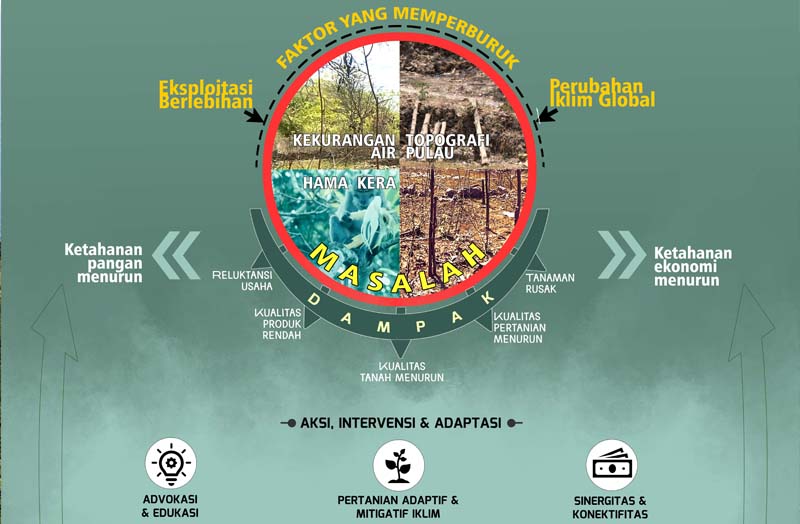

The program development concept in Nusa Penida, particularly in Tanglad Village, prioritizes an integrated approach of education, development, and multi-stakeholder collaboration to address the challenges faced by the local community.
As illustrated in the conceptual framework, the issues occurring in Nusa Penida are closely linked to the island’s ecological and socio-economic characteristics and have been exacerbated by the impacts of the climate crisis. Water has become increasingly difficult to access independently, forcing communities to rely on purchased water, while monkeys have become major agricultural pests, damaging crops. These challenges have led to a cascade of negative effects, including reduced community interest in farming, declining agricultural product quality, soil degradation, land damage, and crop losses. Collectively, these factors threaten both food security and economic resilience in the region.
The program will implement the following activities to mitigate these challenges:
-
Dissemination of information and knowledge sharing
-
Policy and stakeholder lobbying
-
Public awareness and advocacy campaigns
-
Promotion and management of low-impact and sustainable agriculture practices
-
Crop diversification initiatives
-
Land and soil restoration efforts
-
Pest diversion and mitigation initiatives
-
Development of community-based income-generating activities
-
Promotion of women’s participation and leadership
-
Support for non-destructive and environmentally responsible business models
Recognizing the critical importance of water resources, this project will conduct geoelectrical mapping to identify underground water sources and generate subsurface maps that can be shared with the community for informed water management planning. In addition, advocacy and coordination with village authorities will be carried out to strengthen local governance responses and support sustainable water resource management.
--------------------------------------

