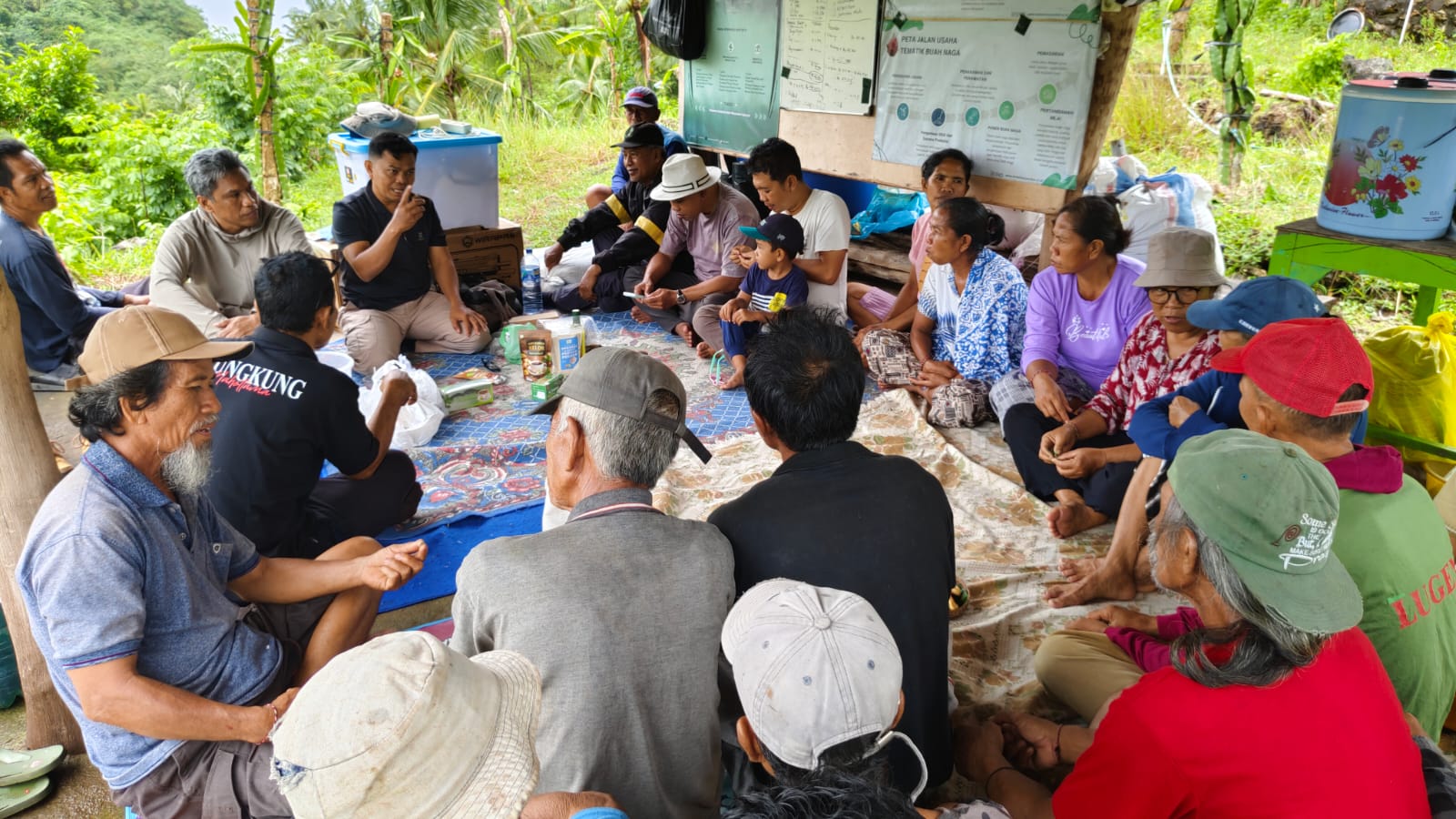

Tanglad, Nusa Penida — Amid rolling limestone hills and stretches of parched farmland in Tanglad Village, a group of residents gathered at the Kedai Masyarakat Foundation Learning House on a cloudy morning.
They were not attending an ordinary agricultural workshop. That day, the community came together to explore how to confront climate change through a little-known commodity: Sacha Inchi.
The capacity-building training was organized to strengthen the village’s resilience to the increasingly visible impacts of climate change. In recent years, Tanglad residents have experienced erratic seasonal patterns. The rainy season arrives late, lasts too briefly—or falls in sudden, intense bursts. The dry season stretches longer than before. Staple crops that once sustained families frequently fail, compounded by persistent monkey attacks that further damage harvests and deepen farmers’ losses.
“Now the seasons are unpredictable. Sometimes we plant and the rain doesn’t come. Other times, the rain arrives during harvest,” said one farmer participating in the training.
The problem extends beyond agriculture. When harvests decline, household incomes shrink. Years of dependence on chemical fertilizers have also diminished the soil’s natural fertility, leaving the land less productive and more fragile.
Faced with these realities, organizers designed a training program that goes beyond farming techniques. It connects agriculture to climate change, emission mitigation, and adaptive economic strategies—framing farming not only as a livelihood, but as part of the climate solution.
The sessions sought to help residents understand that climate change is not a distant issue debated only in international forums. It is a lived reality affecting their fields, kitchens, and family incomes.
Rather than stopping at problem analysis, the training encouraged villagers to see agriculture as part of the answer—through environmentally friendly cultivation practices and the introduction of adaptive crops. This is where Sacha Inchi emerged as a strategic option.
Sacha Inchi: An Adaptive Crop for Marginal Lands
Sacha Inchi, also known as the Inca peanut, is a perennial climbing plant suited to tropical climates. Its characteristics make it well aligned with Tanglad’s agroecological conditions:
- Relatively tolerant of dry land
- Does not require standing water
- Capable of growing in rocky soils
- A perennial crop that does not need replanting each season
As a perennial plant, Sacha Inchi helps maintain soil structure and reduce erosion. Its root system improves soil aeration, while its canopy helps cover the ground, limiting excessive evaporation.
In terms of climate mitigation, perennial crops play a critical role. They absorb and store carbon for longer periods than seasonal crops. Thus, cultivating Sacha Inchi is not only an adaptation strategy—it also contributes to reducing atmospheric carbon concentrations.
Bridging Knowledge and Practice
The training featured Pak Abdurahman, a practitioner and developer of Sacha Inchi products under the brand Incha Key. With experience spanning cultivation, post-harvest processing, and marketing of derivative products, he provided practical insights into building a value chain from farm to finished goods.
“If you only sell raw seeds, the value is small. But when processed into oil, protein flour, or health products, the added value multiplies,” he told participants.
He emphasized that the crop’s success lies not only in planting, but in post-harvest management and quality control. Hygiene standards, proper drying techniques, and careful oil extraction methods are essential to preserving nutritional content and ensuring competitiveness in health markets.
From Seeds to Oil: Unlocking Added Value
One of the most engaging segments of the training was a live demonstration of product processing. Villagers observed how dried Sacha Inchi seeds could be transformed into high-value goods.
1. Roasted Seeds
When roasted correctly, the seeds become a high-protein, low-cholesterol snack with a savory flavor, suitable for marketing as a healthy alternative snack.
2. Sacha Inchi Oil
Using a cold-press method, the seeds are processed into oil rich in:
- Omega-3
- Omega-6
- Omega-9
- Vitamin E
The oil is known for supporting heart health, reducing inflammation, promoting brain function, and improving skin health. Its market value far exceeds that of raw seeds.
3. Protein Flour
The residual press cake from oil extraction is not discarded. Instead, it is processed into plant-based protein flour, which can be blended into bread, cakes, or health beverages.
4. Shells as Biomass
Even the shells have economic potential. They can be used as biomass fuel, charcoal, or compost material.
5. Sacha Inchi Leaf Tea
The leaves can be brewed as a natural infusion, offering an alternative to conventional tea.
This approach reflects the principles of a circular economy—where no part of the plant goes to waste.
Circular Economy at the Village Level
Participants were introduced to the concept of a circular economy, contrasting it with the conventional linear model of plant–harvest–sell–discard. In a circular model, every stage adds value and reintegrates by-products back into productive use.
The simplified chain presented was:
Plant → Harvest → Process → Utilize By-products → Return to Soil or Create New Products.
Such a system ensures:
- Minimal waste
- Maximum added value
- New employment opportunities
- Strengthened local economic resilience
With village-level processing units, economic value remains within the community. Instead of selling raw commodities at low prices, villagers can capture greater profit margins through processed goods.
Economic Adaptation in an Uncertain Climate
As climate change makes traditional agriculture increasingly risky, diversifying income sources becomes essential. Developing an export-oriented crop like Sacha Inchi offers opportunities for income diversification.
Diversification reduces dependency on a single commodity, lowers vulnerability to crop failure, and opens access to global health and nutraceutical markets. Demand for plant-based health products continues to grow steadily, offering rural communities a pathway not merely to survive, but to thrive.
Challenges Ahead
Despite its promise, developing Sacha Inchi production in Tanglad faces several challenges:
- Initial capital for processing equipment
- Product quality standardization
- Market access and distribution channels
- Consistency in production
During discussions, participants stressed the importance of institutional support, such as forming farmer groups or cooperatives, to ensure collective management and shared benefits.
A Symbol of Transformation
As the training drew to a close, discussions grew more animated. Participants began talking not only about planting techniques but about establishing a joint business unit.
The initiative represents more than knowledge transfer. It signals a shift in awareness: climate change demands collective, innovative strategies.
Sacha Inchi is envisioned as a symbol of transformation:
- From conventional farming to adaptive agriculture
- From chemical dependency to environmentally responsible practices
- From selling raw materials to producing value-added goods
- From a linear economy to a circular one
If managed effectively, the crop could become a new flagship commodity for Tanglad Village.
Conclusion
Amid increasingly complex climate challenges, the capacity-building training in Tanglad marks a concrete step toward village resilience.
Through adaptive and mitigation-based management of Sacha Inchi, residents are learning not only how to cultivate a crop, but how to navigate a changing era. They are discovering that climate solutions can grow from their own fields.
On the rocky drylands of Nusa Penida, a new hope is beginning to spread—like the steady vines of Sacha Inchi itself, slowly but surely strengthening the soil and bearing fruit for the village’s future.
<<------------------------------------>>

